This is an old revision of the document!
Experiential learning is a cycle learning theory developed by David Kolb in 1980s and was inspired by earlier works of Kurt Lewin. As it was developed within humanist ideas, experiential learning offers a holistic perspective on learning and is orientated mostly on adult learning.
In his influential book “Experiential Learning: Experience As The Source Of Learning And Development” (1984) Kolb describes learning as “the process whereby knowledge is created through the transformation of experience”. Kolb differs between cognitive learning (meaningless knowledge) and experiential learning (significant, applicable knowledge which addresses the needs of the learner). In order to be effective, learning should incorporate following four stages:
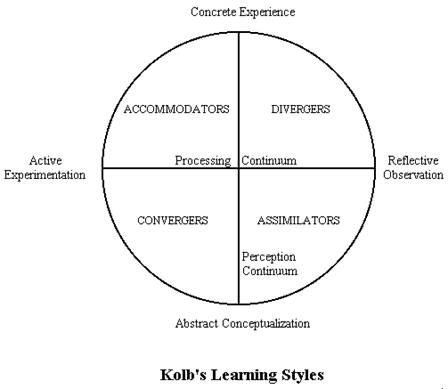
Mentioned stages follow one after another forming a circle as they were introduced above, yet the process of learning can begin in any of them. Still, every learner develops strengths in some of mentioned stages more than in others and learn better in those conditions, what results in four learning styles identified also by Kolb:
Relations between learning styles and learning stages can best be viewed through a graphical representation.
In order to identify preferred learning style in Kolb's model, “learning style inventory” method has been developed. This method for determining an individual’s optimal learning style, strengths and weaknesses consists of a survey which explores one's perceiving (how one prefers to acquire information) and processing (how one makes sense of new things).
Experiential learning is a model suggested for adult learners. General implications of this model are that teaching/learning process should consist of all four stages of Kolb's model, but it also suggests individual changes should be applied, depending on learners learning style.
Experiential Learning (Kolb) at Learning Theories.
TIP: Theories. Experiential Learning.
Lowy, Alex, and Phil Hood. The power of the 2×2 matrix: using 2×2 thinking to solve business problems and make better decisions. John Wiley and Sons, 2004.
Kolb, David A. Experiential Learning: Experience as the Source of Learning and Development. Prentice-Hall, Inc., Englewood Cliffs, N.J. 1984.
Kolb, David A. Learning style inventory. Boston, MA: McBer and Company. 1985.


 English
 Hrvatski